Why a Small 7 Brew Stand Can Require a Million-Dollar Investment
A 7 Brew stand occupies about 510 square feet, yet opening one can cost more than $1 million. Preparing the surrounding property, installing equipment, and getting the team ready all contribute to the price.
The estimated 7 Brew franchise cost is $940,500 to $2,283,500, according to the May 2026 Franchise Disclosure Document (FDD). That covers the first traditional store and includes an upfront development payment tied to a ten-store commitment. Further funding is needed to open the remaining locations.
The Property Is Much Larger Than the Building
The stand’s footprint gives little indication of the land needed around it. The FDD describes typical properties ranging from 8,000 to 50,000 square feet, accommodating the building, vehicle lanes, and access through the site.
Customers need to enter safely, wait without blocking access, and leave after collecting their drinks. Making that possible takes space and planning.
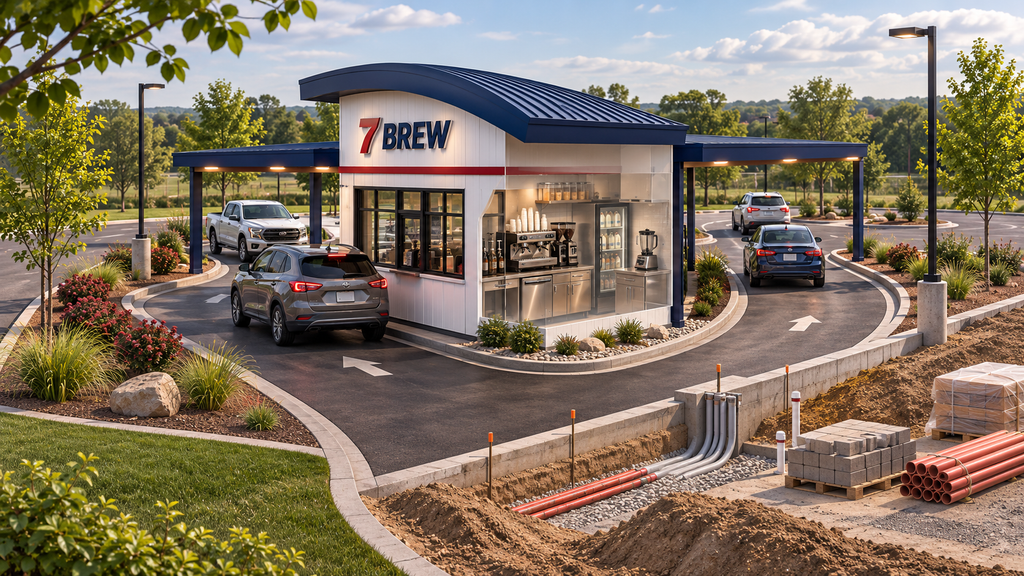
Preparing the Land and Connecting Utilities
Before a stand can operate, the property may need grading, paving, lighting, landscaping, sidewalks, and utility connections. The work depends on what is already there.
A prepared plot in an existing shopping center might have some infrastructure in place. An undeveloped parcel could need extensive improvements before it can accommodate the same building. Comparing the two means looking beyond the rent or asking price to what each site needs.
Making Room for Drive-Thru Traffic
The entrance, ordering lanes, and exit have to work together, particularly when cars arrive faster than orders can be completed.
An awkward layout can cause problems even on a visible property. Architectural and engineering work helps establish how the building, utilities, and vehicle routes will fit before construction begins.
Where the Opening Budget Goes
The opening investment combines several projects: preparing the property, providing the building, and equipping it for daily service.
| Major expense | What it covers |
| Site development | Paving, utility connections, lighting, landscaping, and other property improvements. |
| Building and build-out | The modular structure and work needed to prepare it for operation. |
| Equipment and systems | Drink preparation, refrigeration, storage, and order processing. |
Permits, professional fees, opening inventory, insurance, and training-related travel also need a place in the budget. These expenses may attract less attention than construction, but they still have to be paid before the business gets going.
Why Modular Construction Still Carries Substantial Costs
A modular building can arrive looking close to finished, but the property must be ready to receive it. Delivery and installation need arranging, and the building needs utility connections and equipment before employees can work inside.
Lowering the stand into place is only one stage of opening the location. Much of the groundwork happens beforehand, with further preparation needed before service begins.
What Has to Fit Inside the Stand
The 7 Brew menu spans espresso drinks, energy drinks, flavored sodas, teas, lemonades, smoothies, and shakes. Preparing that range requires equipment for different tasks, ingredient storage, and a dependable supply of ice.
An espresso drink and a blended smoothie follow different preparation steps. Milk and other perishable ingredients need refrigeration. Cups, lids, syrups, and cleaning supplies need accessible storage without overwhelming the workspace.
Equipment Placement Matters in a Small Space
Employees need room to prepare orders and move around one another. Keeping frequently used ingredients within reach and arranging equipment sensibly can make a compact workspace easier to use, especially during a rush.
Expenses Beyond the Building
The published investment range has exclusions. Buying the land is one of them: the estimate provides for rent and a security deposit rather than a property purchase.
Other expenses identified in the FDD’s notes include:
- Freight and installation of the modular building.
- Certain local impact fees and utility-related charges.
- Performance bonds where required.
Responsibility for property improvements also deserves attention. Before comparing two leases, an operator needs to establish what the landlord will provide and what the business must fund.
Bills continue after opening, including wages, supplies, rent, and utilities. The FDD’s three-month funding allowance is a budgeting estimate; it does not establish when a store will become profitable. It also excludes an owner’s salary or draw.
The Commitment Goes Beyond One Store
The May 2026 FDD requires new franchisees to develop at least ten traditional stores. The first-store estimate includes the upfront development payment, but opening the remaining locations takes additional funding. Each site needs its own budget.
As of November 5, 2026, 7 Brew is not accepting new franchise applications or expressions of interest.
The stand may be compact, but the investment covers a working drive-thru location from the ground preparation and utility connections to the equipment inside.